Bitcoin Is Money In Every Sense
Economists define money by three functions: it must store value over time, serve as a medium of exchange for goods and services, and function as a unit of account for pricing and measurement. For decades, Bitcoin critics claimed it failed these tests. Too volatile to be a store of value, they said. Too slow and expensive for daily transactions, they argued. Too niche to serve as a unit of account for the broader economy, they insisted. These critiques were never true—they were simply observations of an emerging technology in its infancy, judged against mature systems that had centuries to develop. Today, Bitcoin fulfills all three functions of money. It preserves purchasing power across years and decades better than inflationary fiat currencies. It enables instant, low-cost transactions through the Lightning Network and efficient base-layer settlement for larger transfers. It serves as the unit of account for a growing economy of Bitcoin-native businesses, priced in sats rather than dollars. Bitcoin is money in every sense—store of value, medium of exchange, and unit of account. The only remaining question is how long the world will pretend otherwise.
Fiat Money Fails All Three Functions Of Money
Fiat currencies fail as a store of value. The dollar has lost over 90% of its purchasing power since the Federal Reserve’s creation. The euro, yen, pound—no major fiat currency maintains value over time. Savers are punished rather than rewarded. Retirement accounts that should grow instead struggle to keep pace with inflation. Money is supposed to preserve the value of your labor across time, enabling you to store today’s effort for tomorrow’s needs. Fiat currencies accomplish the opposite—transferring value from savers to debtors, from workers to asset holders, from the present to the politically connected. How is this store of value?
Traditional payment rails fail as a medium of exchange. Cross-border transfers take days and cost 30% in fees for small remittances. Merchants wait 30-90 days for settlement and face 3% processing fees plus chargeback risks. Bank transfers require business hours, branch visits, and multi-day clearing. The medium of exchange is supposed to enable commerce—yet legacy financial infrastructure creates friction, cost, and delay that choke economic activity. A merchant in Kenya cannot easily sell to a customer in Canada. A refugee cannot receive funds from family abroad. How is this medium of exchange?
Government currencies fail as a unit of account for the global economy. Prices are denominated in hundreds of different currencies, requiring constant conversion, hedging, and exchange risk management. International trade carries currency risk that adds cost and uncertainty to every transaction. Small economies face dollarization or monetary policy imposed by larger neighbors. The unit of account is supposed to provide a common measure for value—yet currency fragmentation creates friction, confusion, and exclusion. How is this unit of account?
The system fails the very definition it claims to uphold. Fiat money is defended as necessary because it serves the three functions of money. Yet it demonstrably fails at all three. It does not store value—it destroys it through inflation. It does not facilitate exchange—it impedes it through friction and surveillance. It does not provide a common unit of account—it fragments the global economy into currency fiefdoms. The defense of fiat rests on theoretical functions that practice has long since disproven. Why do we accept failure as standard?
Bitcoin Is Money In Every Sense
Bitcoin fulfills all three functions of money better than the alternatives. It stores value through absolute scarcity—21 million coins, no more, ever. It serves as a medium of exchange—fast, cheap, global, permissionless. It functions as a unit of account—an emerging standard for a borderless economy. Bitcoin is not money in theory. It is money in practice, in every sense that matters.
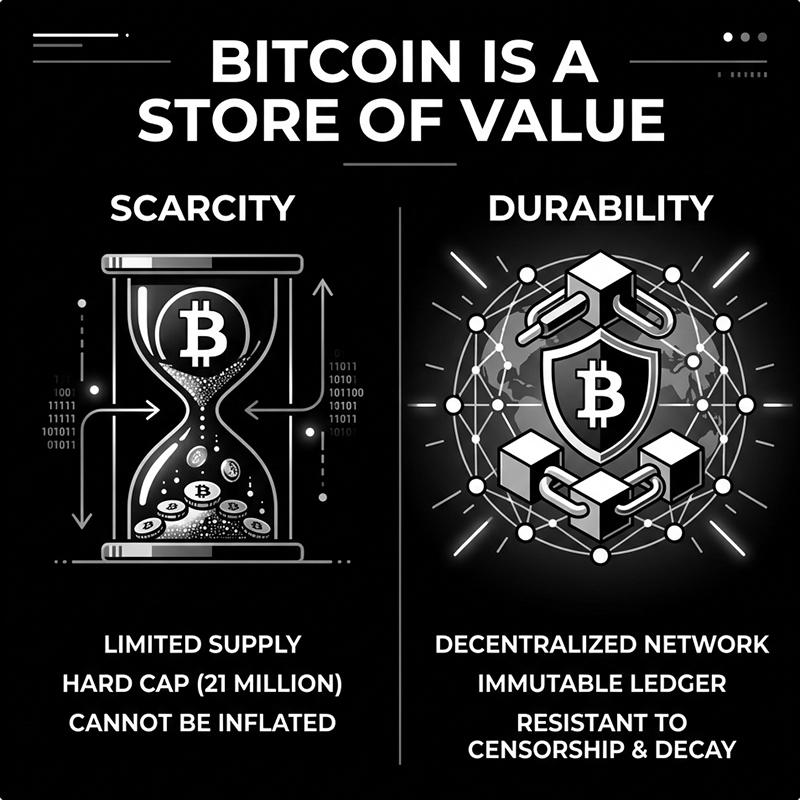
Bitcoin stores value through verifiable scarcity. Unlike fiat currencies that can be printed infinitely, Bitcoin’s supply is fixed and transparent. Every four years, new issuance halves. Eventually, no new Bitcoin will be created. This scarcity ensures that your percentage of total supply remains constant—no inflation dilutes your holdings, no central bank devalues your savings. Over its history, Bitcoin has appreciated dramatically, rewarding savers rather than punishing them. Volatility decreases as adoption grows, but the underlying scarcity guarantees long-term value preservation. What is a store of value worth when its supply cannot be manipulated?
Bitcoin serves as a medium of exchange globally. Base layer transactions settle in minutes, secured by proof-of-work. Lightning Network enables instant, nearly-free transactions for daily commerce. A merchant in Kenya can receive payment from Canada in seconds. A refugee can access funds from family without banking infrastructure. There are no business hours, no geographic restrictions, no minimum amounts, no account freezes. The medium of exchange functions as it should—enabling commerce rather than impeding it. What becomes possible when exchange is truly permissionless?
Did you get?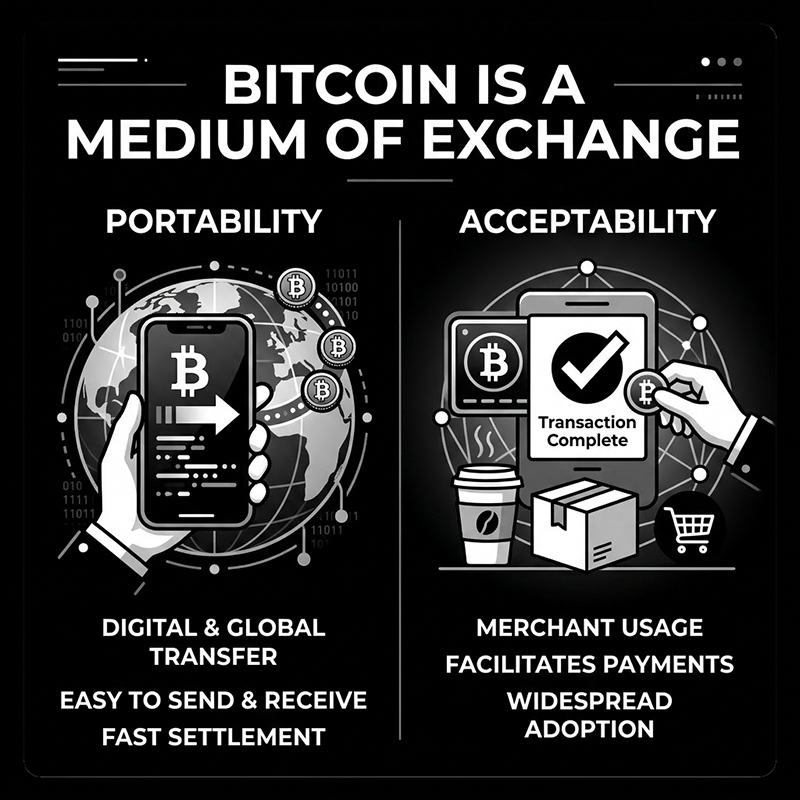
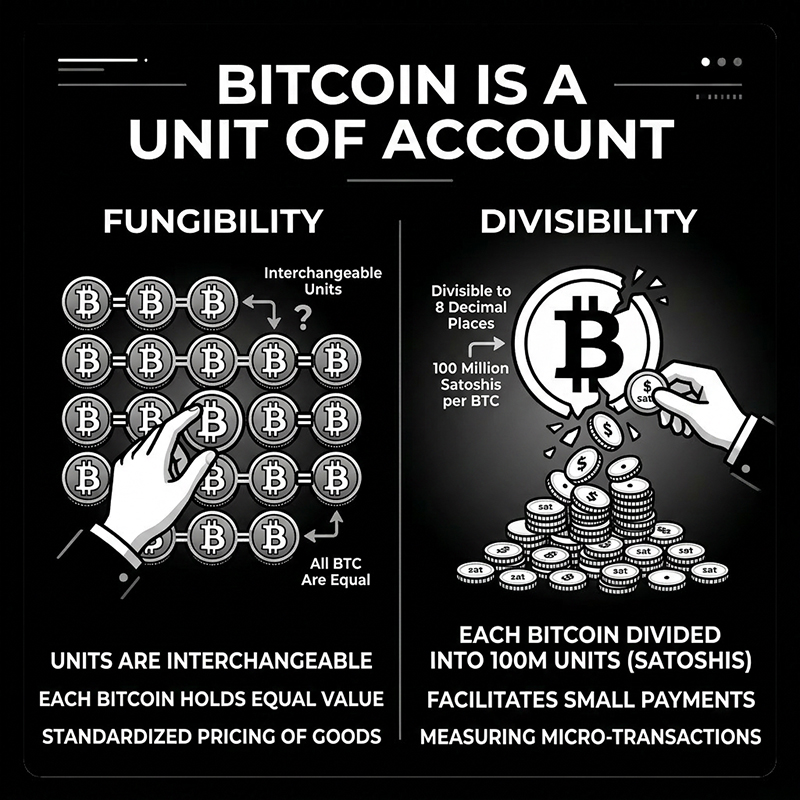
Bitcoin functions as a unit of account for the borderless economy. Bitcoin-native businesses price goods in satoshis—the smallest unit of Bitcoin—rather than fluctuating fiat currencies. International trade settles without currency conversion or hedging costs. The unit of account is consistent globally, accessible to anyone, controlled by no government. As adoption grows, pricing in Bitcoin becomes increasingly practical. The volatility that early critics cited diminishes with market depth and liquidity. What emerges when value has a common measure across all borders?
The three functions reinforce each other in Bitcoin. Scarcity makes it valuable to store, which creates demand for exchange, which increases liquidity and stability for unit of account. Unlike fiat systems where inflation undermines all three functions simultaneously, Bitcoin’s design strengthens each function through the others. Store of value drives adoption. Medium of exchange enables commerce. Unit of account provides coordination. The system is coherent rather than contradictory. How different is money designed for function rather than control?
Bitcoin Is Money In Every Sense. Use Bitcoin.
The definition of money is not arbitrary—it reflects what civilization needs to coordinate economic activity. A store of value preserves effort across time. A medium of exchange enables trade without barter. A unit of account provides a common language for value. These functions are essential; they are why money exists. Bitcoin is money in every sense. It stores value through mathematical scarcity. It serves as a medium of exchange through global, permissionless transactions. It functions as a unit of account for an emerging borderless economy. Critics who claimed Bitcoin could never be money were wrong—not because the definition changed, but because Bitcoin grew into the definition. The three functions of money are not aspirational goals for Bitcoin. They are operational realities today, used by millions of people worldwide for savings, commerce, and coordination. Fiat currencies fail these tests. Bitcoin passes them. The choice is clear. Use money that works in every sense. Use Bitcoin.